
Chapter 1
Woman Skips Family Vacation Over Father's Unfair Cabin Sleeping Arrangement
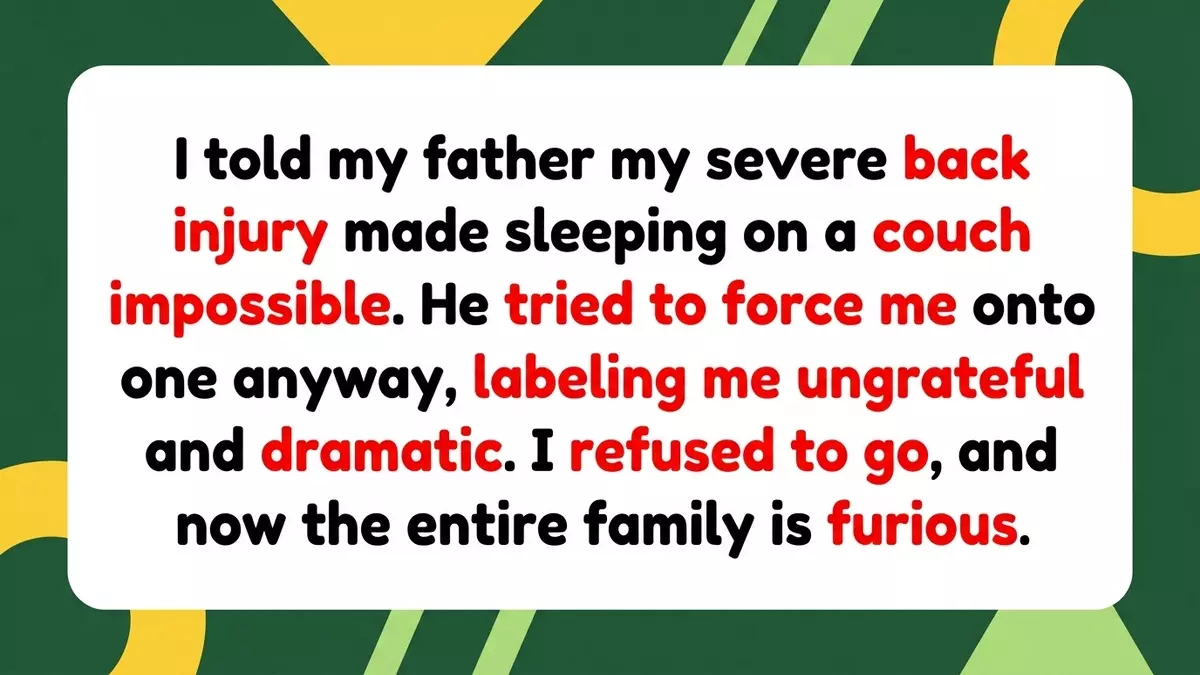
Many people are familiar with the exhausting feeling of being the family underdog—the person who is always expected to compromise their own comfort to preserve group harmony. For one 24-year-old woman, a lifetime of playing second fiddle to her older siblings finally reached a painful breaking point. When her father planned an annual family getaway to the mountains, she initially looked forward to a fun summer retreat. Instead, she found herself staring down a familiar, highly unfair lodging arrangement that ignored her severe health constraints.
The conflict did not stem from the vacation destination itself, but from the allocation of the sleeping quarters. Dealing with a chronic slipped disc, the young woman had to draw an absolute hard line in the sand, even if it meant triggering her family’s immediate disapproval. This was far more significant than simply complaining about a poor night’s sleep; it was about establishing personal worth in a household dynamic that consistently put her needs last. Her physical health was actively on the line, yet her relatives expected her to quietly fall in line as she always had during childhood. When rigid childhood roles refuse to die, the transition into adult-to-adult relationships within a family can feel like an impossible uphill battle.

Woman Skips Family Vacation Over Father's Unfair Cabin Sleeping Arrangement
The Persistent Trap of Unconscious Family Role Rigidity
The story sets a scene that should have been a cozy annual tradition, but deeply rooted psychological friction was already at play. As concrete plans for the summer mountain cabin began to take shape, the narrator quickly realized that her parents' behavioral expectations had not shifted since she was a young child. When organizing group accommodations, families frequently fall back into automated habits, assuming the youngest child will naturally absorb the worst arrangements.
When the cabin's room count was finalized, the math simply did not add up fairly. The older siblings were immediately assigned private, comfortable bedrooms with proper mattresses, while the narrator was left as a logistical afterthought. Realizing she was once again expected to sacrifice her basic comfort, she reflected on the severe physical toll a week on an unsupportive couch would take on her injured spine.
The Broken Promise and the Boundary Violation
A sudden shift in the family logistics exposed a glaring empty promise. The father had initially assured the daughter that proper sleeping arrangements would be secured to accommodate her back condition. However, as the departure date drew near, he completely backtracked on his word, attempting to force her onto a standard living room sofa instead.
This left the daughter with an incredibly difficult choice: endure a week of severe physical agony or face intense family disapproval for breaking tradition. To protect her medical well-being, she made the bold choice to formally opt out of the trip, triggering a wave of defensive anger from her relatives.
The Psychology of Birth Order Bias and Systemic Blame
Standing up to family members who expect you to absorb physical discomfort for their administrative convenience is a monumental emotional hurdle. In developmental psychology, this dynamic is recognized as a textbook example of birth order bias and systemic family role rigidity.
Youngest Child Cast as Perpetual "Baby" ──> Expected to Yield to Older Siblings ──> Adult Boundaries Disregarded
According to family counseling experts studying birth order dynamics, the youngest child is frequently cast as the perpetual "baby" of the household, even well into their twenties and thirties. Within this toxic cycle of compliance, the youngest sibling is sub-consciously expected to continuously adapt, yield, and compromise to maximize the convenience of the older siblings and parents. This deeply ingrained hierarchy breeds a systemic lack of respect for the youngest adult’s physical, medical, and emotional boundaries.
The Deflection of Guilt
When a family completely minimizes a legitimate medical crisis like a slipped disc, the situation crosses the line from a mild birth-order annoyance into a severe boundary violation. The family’s immediate reaction to her refusal—labeling the daughter as "ungrateful" or a "spoiled drama queen"—is a classic psychological defense mechanism utilized to preserve the established family hierarchy.
Instead of taking accountability for booking an inadequate cabin that failed to house everyone safely, the family projects the entirety of the blame onto the victim for refusing to suffer in silence. This cognitive shift allows the parents and older siblings to avoid facing internal guilt for their profound lack of consideration and logistical selfishness.
How to Navigate Toxic Vacation Logistics
For adult children trapped in similar high-pressure household dynamics, psychologists offer concrete advice on how to successfully establish adult boundaries without getting sucked into screaming matches.
-
State Clinical Limitations Without Emotion: When explaining why you cannot accept an arrangement, state your physical medical boundaries clearly and neutrally, as if you are a doctor delivering a diagnosis. Avoid entering into a circular emotional debate or J.A.D.E.-ing (Justifying, Arguing, Defending, Explaining) your medical reality to people who refuse to validate it.